


So here’s the direct answer. Website design cost in 2026 starts around $200 to $800 for a do it yourself builder in year one. A professionally built small business site usually runs $3,000 to $15,000. A custom ecommerce store often lands between $25,000 and $150,000 or more. Then you add yearly costs, which often run $600 to $6,000 for a small business site.
Why is the gap so huge? You’re not buying “a website.” You’re buying design, code, content, hosting, security, and support. Strong Website Design Services bundle those pieces and show what each one costs.
Professional Website Design adds strategy, testing, and speed work. Custom Website Design Services build the layout and features around your business instead of squeezing you into a template.
This guide breaks down every line of your budget. You’ll learn what’s fair, what’s padded, and which quote tricks to dodge. Let’s get into it.
Planning Your Website Budget?
Get a website that fits your business needs and budget. Explore our professional website design solutions to understand your options and plan your next project with confidence.
Ready to Get Started? Get Your Free Proposal Today!KEY TAKEAWAYS
- Balancing Front End & Back End: Building a modern website in 2026 requires balancing front end user experiences with back end functionality.
- Core Pricing Ranges: Basic small business sites range from $3,000–$15,000, mid-size platforms cost $10,000 to $50,000, and complex enterprise or e-commerce ecosystems run from $30,000 to over $100,000.
- Budget Planning Requirements: Plan for ongoing maintenance, third-party API fees, and technical SEO infrastructure to avoid hidden operational budget traps.
- Digital Real Estate Approach: Treat your web build like digital real estate, cutting corners on the structural foundation causes the whole system to collapse when real traffic hits.
- Realistic Cost Expectations: Thinking website design cost is as simple as buying a domain and picking a template leads to expensive rework.
How Much Does Website Design Cost in 2026?
Here are the numbers most buyers need first. These ranges blend published 2026 guides from WebFX, Clutch, WebsiteSetup, and others.
- DIY builder site. About $200 to $800 in year one, plus your own time.
- Freelancer built site. About $1,500 to $8,000 for a small business.
- Small agency built site. About $3,000 to $15,000 for a small business.
- Custom ecommerce store. About $25,000 to $150,000 or more. Template based stores cost far less.
- Yearly upkeep. About $600 to $6,000 for a small business site.
How you read these numbers matters just as much as the numbers. We label every figure in this post one of three ways. Verified means a named source published it.
Estimate means we rounded a range from several sources. Example means we made up a business to show the math. Keep the three apart, especially when a salesperson quotes you “the industry average.”
Prices also move fast. Platform pricing shifted in 2025, and WebsiteSetup says AI assisted tools trimmed build hours for small sites in 2026. We checked every U.S. figure on October 19, 2026.
Also remember that design and development are separate jobs. Design is the look and flow. Development is the code that makes it work. Most quotes blur them together, so ask for each one priced separately.
Understand Website Development Costs in 2026
Website development cost means everything it takes to plan, design, build, and launch a site. It’s the whole price tag, not just the pretty part. Many people use “design cost” and “development cost” like they’re twins. They aren’t.
Design covers layout, colors, fonts, images, and how people move through your pages. Development covers the code, the database, the content system, and the tools that connect to your site. You need both. A gorgeous design with weak code loads slowly. Strong code with sloppy design confuses visitors.
Here’s the big picture for 2026. WebFX reports that a website can cost anywhere from $10 to more than $100,000, depending on who builds it and how complex it is. The same source puts DIY builders at about $17 to $500 per month and professional designs at $500 to $30,000 or more.
Clutch says most web design projects reviewed on its platform cost less than $10,000, and shortlisted agencies charge around $100 to $149 per hour.
Those numbers look messy because the market is messy. A solo freelancer, a ten person agency, and a national firm all sell “a website.” They deliver very different things.
So what actually moves the price? Three things dominate.
- First comes scope, meaning how many pages and features you want.
- Second comes who builds it.
- Third comes how custom the design and code are.
Everything else is a smaller lever. Get those three right, and you control most of your website design budget.
Think of it like building a house. A studio, a family home, and a hotel all have walls and a roof. The blueprint sets the bill.
Break Down the Core Components of Your Website Budget
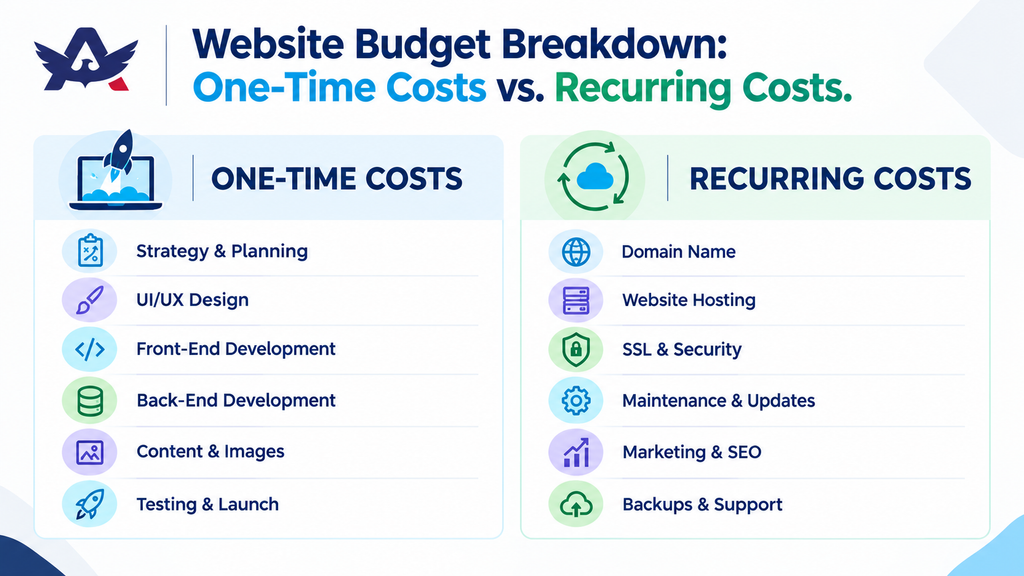
Every website budget has two buckets. One time costs hit before launch. Recurring costs keep the site alive after launch. Most first time buyers only plan for the first bucket, and that’s how surprise bills happen. That split also explains why website design cost feels so slippery.
One time costs include strategy, design, development, content, images, testing, and launch work. Recurring costs include hosting, your domain, security, backups, updates, support, and marketing. A site that costs $8,000 to build can easily cost $1,000 or more per year to run well.
Use the tables below as a starting map. Pricing units matter, so we list them. Rows marked Verified come from named sources. Rows marked Estimate are our own rounded ranges.
One-Time Costs
| Cost Item | What It Covers | Typical Range | Pricing Unit | Basis |
| Strategy and Planning | Goals, sitemap, competitor review | $300 to $2,000 | Per project | Estimate |
| UI and UX Design | Layouts, visuals, prototypes | $800 to $5,000 | Per project | Estimate |
| Front End Development | Code for what visitors see | $1,000 to $5,000 | Per project | Estimate |
| Back End Development | Database, logic, content system | $1,000 to $6,000 | Per project | Estimate |
| Content and Images | Copy, photos, graphics | $300 to $3,000 | Per project | Estimate |
| Testing and Launch | Speed, forms, device checks | $200 to $1,000 | Per project | Estimate |
Recurring Costs
| Cost Item | What It Covers | Typical Range | Pricing Unit |
| Domain Name | Your web address | $10 to $35 | Per year |
| Hosting | Server space for your site | $100 to $500 | Per year |
| SSL Certificate | Padlock and data encryption | $0 to $300+ | Per year |
| Maintenance | Updates, backups, fixes | $600–$6,000 | Per month |
| Marketing and SEO | Traffic and leads | Depends on goals | Per month |
Add up the one-time rows and you get roughly $3,600 to $22,000. A basic brochure site lands near the low end. A site with accounts, bookings, or custom tools climbs fast. Don’t treat these tables as a quote. Treat them as a question list.
When a proposal skips a row, ask why. Sometimes the answer is “you don’t need it.” Sometimes the answer is “we forgot,” and that costs you later.
Compare Front End and Back End Development Costs
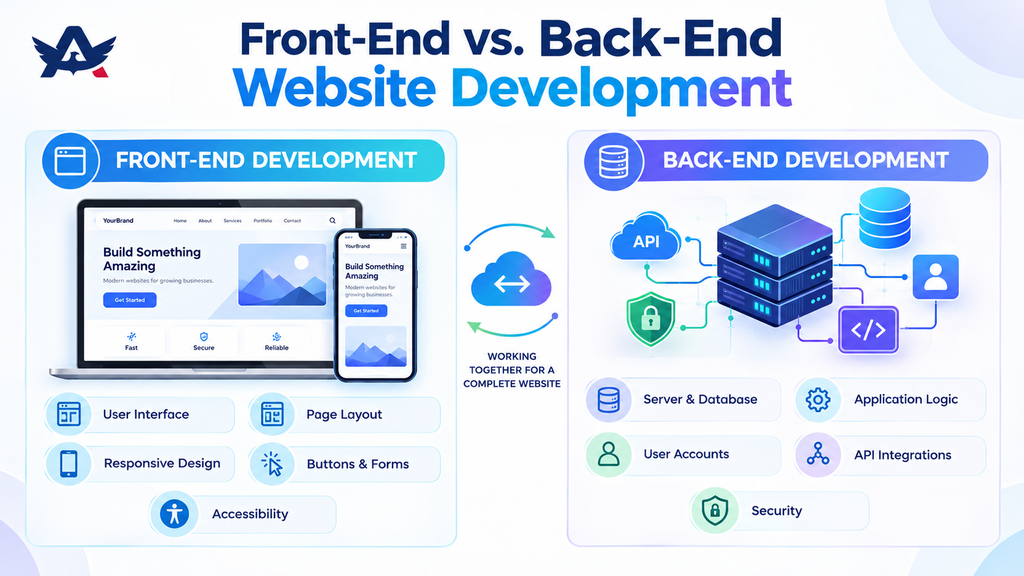
Front end is everything a visitor sees and touches. Buttons, menus, forms, fonts, and animations all live there. Back end is everything behind the curtain. Databases, servers, user accounts, payment logic, and the admin area live there.
Front end costs depend on how many unique page layouts you need. Fifty blog posts on one template cost far less than ten custom layouts. Responsive behavior, meaning the site adapts to phones and tablets, adds testing time. So do accessibility fixes and speed work. WebFX puts responsive web design at roughly $3,000 to $25,000 or more, depending on size and provider.
Back end costs depend on what your site must remember and do. A brochure site needs little. A site with logins, bookings, memberships, or custom pricing needs a lot. This is where budgets jump. Elementor notes that membership plugins alone run $150 to $300 per year, plus setup time.
| Layer | Basic site | Mid-range site | Complex site |
| Front end | $1,000 to $3,000 | $3,000 to $8,000 | $8,000 to $25,000 or more |
| Back end | $500 to $2,000 | $2,000 to $10,000 | $10,000 to $50,000 or more |
All figures above are estimates priced per project. Hourly rates shape them too. Dribbble puts freelancers at $50 to $150 per hour, and Clutch reports about $100 to $149 per hour for agencies on its shortlists. Rates climb with seniority, so ask who will do the work.
Platform choice also shifts work between the two layers. A hosted platform like Shopify handles much of the back end for you.
A custom build puts every database and security task on your bill. Most web design pricing shows one lump sum, which hides all of this. Ask each quote to split front end and back-end hours. If you can’t see the split, you can’t judge what you’re buying.
Evaluate UI and UX Design Costs and Their Impact
UI means user interface. It’s how the site looks. UX means user experience. It’s how the site feels to use. Good UX answers one simple question. Can a stranger find your phone number in five seconds?
Costs vary a lot. WRTeam puts a full design for a five to ten page small business site at about $1,000 to $5,000. DesignMonks lists $2,500 to $8,000 for a small site of five to eight pages.
Twine reports static screens at roughly $100 to $500 each and low detail wireframes at $50 to $100 each. Parallel says UX rates run from about $25 per hour for freelancers to $200 or more for senior agency designers.
What drives those numbers? Web design cost climbs when you add user research, usability testing, extra revision rounds, accessibility checks, and design system documents, according to Parallel.
WRTeam adds that most fixed price projects include two to three revision rounds, so every extra round costs extra.
Now the impact. Responsive Web Design Services make sure your layout works on every screen size. That matters because Business.com, citing Statista, says over half of all website traffic comes from mobile devices. A design that only shines on a laptop leaves half your visitors squinting.
Good UX also protects revenue. A confusing checkout or a buried contact form quietly kills sales, and nobody tells you why. You just see fewer leads. A pretty site that confuses people is an expensive poster.
Here’s what to demand in a UI and UX quote. Ask for wireframes, a clickable prototype, mobile layouts, a revision limit, and accessibility basics. If a quote lists only “design,” ask what that word means. Then ask what happens when you want a third round of changes.
Estimate Admin Panel Development Costs
An admin panel is your control room. It’s where you edit pages, upload products, answer orders, and manage users without calling a developer.
Most small sites don’t need a custom one. WordPress, Shopify, Wix, and Squarespace all ship with admin areas, and you get them with your plan. That’s the cheapest path, and it’s the right call for most small businesses.
Custom panels cost real money. Cadence estimates admin dashboards at $2,000 to $40,000 depending on scope, and says a simple version for an early stage founder should land under $3,000. Esparkinfo lists admin panel work at about 50 to 170 hours, or roughly $2,500 to $8,500. A Hackernoon guide says building a full dashboard from scratch can take 500 to 1,000 hours and cost $25,000 to $50,000.
Features push the price. Role based access, approval workflows, reports, audit logs, and secure login each add days of work. Cadence calls hand built login security a $3,000 mistake in 2026, because it keeps costing you after launch. Plan for security updates too. Admin areas attract attackers, so they need patches like every other part of your site.
Want to save money? Start with your platform’s built in admin. Use a template or a low code tool for dashboards. Cadence also suggests prototyping in Retool first, even if you plan to go custom, and says a few smart moves can save 30% to 60% on builds.
Ask one question before you pay for a custom panel. Can an existing tool do 80% of this? If yes, buy that tool and customize the last 20%. You’ll launch sooner, and you’ll spend less on upkeep.
Calculate Third Party Integration Costs for Your Website
Third party tools connect your site to other services. Think payment processors, email platforms, booking tools, CRMs, maps, and analytics. The tool may be free. Connecting it isn’t.
Here’s the rule that surprises founders. One cost estimator says connection work usually costs two to five times what a tool’s pricing page suggests. The service itself is cheap. The developer time, testing, and error handling aren’t.
Ficode lists simple connections, like a contact form to a CRM or a payment gateway setup, at $1,500 to $5,000 and one to two weeks. Complex work, like linking an ERP and a CRM, runs $15,000 to $50,000 or more and six to sixteen weeks. Project Cost Estimator prices payment gateway work at $1,200 to $7,000 depending on scope.
Then come recurring costs. Netguru notes that payment gateways commonly charge 2.9% plus $0.30 per transaction. Third party tools also change versions without warning. One pricing guide for connected tools suggests setting aside 15% to 20% of the project cost each year for upkeep.
Before you sign, list every tool your site must connect to. Next, ask your developer three questions.
Who pays when a third party changes its system?
Does the quote include error handling? What happens if the service goes down for an hour?
Here’s a quick example. Say your bakery site connects to a payment tool and an email list. That’s two connections, so you’re near the simple tier. Add a CRM, a booking system, and an accounting tool, and your quote jumps to the complex tier. Every new connection multiplies the testing.
Estimate the Cost of Building a Small Business Website
Building a small business website can cost anywhere from a few hundred dollars to several thousand dollars, depending on your needs. A simple website with a few pages usually costs less than a custom site with advanced features, booking systems, or ecommerce functionality.
Your total budget also depends on whether you use a website builder, hire a freelance developer, or work with a professional agency. Before choosing an option, consider your design requirements, number of pages, content needs, hosting, and ongoing website Maintenance Services.
Understanding these expenses helps you set a realistic budget and choose a website solution that supports your business goals.
Cost of Website Design for Small Businesses in 2026
Small business sites usually have five to fifteen pages. You’ll likely want a home page, services, about, contact, and maybe a blog or booking tool. The cost of website design for that scope varies, but the sources agree more than you might expect.
WebsiteSetup puts full service agency work at $5,000 to $15,000 for a complete small business site that covers strategy, design, development, and content. UENI reports an average of $3,000 to $10,000. A DEV Community analysis finds that most small service businesses, such as roofers, cleaners, and photographers, spend $1,500 to $5,000 with a freelancer or small agency.
A 2024 Clutch survey, cited by TechLion Dev, found that 36% of small businesses spend between $1,000 and $10,000, with a median near $5,000.
Most owners land between $3,000 and $10,000 for a site that looks sharp and brings in leads.
Local Needs and Affordable Options
Location matters a bit. If you’re searching for custom website design Sandy Springs businesses can trust, look for a team that shows real local examples, explains local SEO setup, and writes a clear scope. Where the team sits won’t change the price much. Local know how can help you show up in map searches, though.
Affordable Website Design Services exist at every level. “Affordable” shouldn’t mean cheap and thin. It should mean you pay a fair price for what you get. A bargain site that needs a rebuild in a year costs more than a fair site built right.
Here’s a smart move. Start with the pages that make money. A five page site that converts beats a thirty page site that confuses. Adding pages later is usually simpler than fixing a bloated first build.
Ready to Build Your Business Website?
From simple business websites to custom web solutions, American Design Agency LLC helps you choose an approach that aligns with your goals, features, and budget.
Let’s Plan Your Website — Get a Free Proposal!Compare Website Development Costs by Business Type
Different businesses need different websites. A plumber needs a phone number front and center. A bakery needs online orders. A software company needs logins and dashboards. Web design cost follows those needs.
The table compares the main website types. Ranges blend the sources listed at the end and count as estimates. Where one source drove a number, we name it below the table.
| Website type | Estimated design and build cost | Typical features included | Ongoing yearly expenses |
| DIY builder site | $200 to $800 in year one | Templates, drag and drop editor, basic SEO tools | $150 to $600 |
| Freelancer small business site | $1,500 to $8,000 | 5 to 10 pages, forms, mobile layouts, basic SEO | $600 to $3,000 |
| Agency small business site | $5,000 to $15,000 | Strategy, custom design, content help, analytics | $1,200 to $6,000 |
| Template ecommerce store | $3,000 to $10,000 | Product pages, cart, payments, shipping setup | $1,500 to $6,000 plus transaction fees |
| Custom ecommerce store | $25,000 to $150,000 or more | Custom design, third party connections, advanced catalog tools | $6,000 to $30,000 |
| Mid size business site | $10,000 to $50,000 | Many page types, content system, strict branding | $3,000 to $9,000 |
| Enterprise site or web app | $50,000 to $150,000 or more | Custom logic, user accounts, APIs, security reviews | 15% to 25% of build cost |
Sources behind the table. OuterBox puts custom ecommerce at $25,000 to $150,000 or more. First Pier lists Shopify freelancer builds at $3,000 to $10,000.
Pixeto, citing Clutch, says most agency projects for mid market clients land between $10,000 and $49,999. WebsiteSetup lists mid size marketing site upkeep at $250 to $750 per month and ecommerce upkeep at $500 to $2,500 per month. Elementor puts DIY creator spending at $150 to $600 per year.
Industry matters too. Restaurants need online menus and ordering. Clinics and law firms need intake forms and careful privacy settings. Contractors need photo galleries and quote forms. Each feature adds hours, so tell your designer your industry on day one.
Calculate E Commerce Website Development Costs
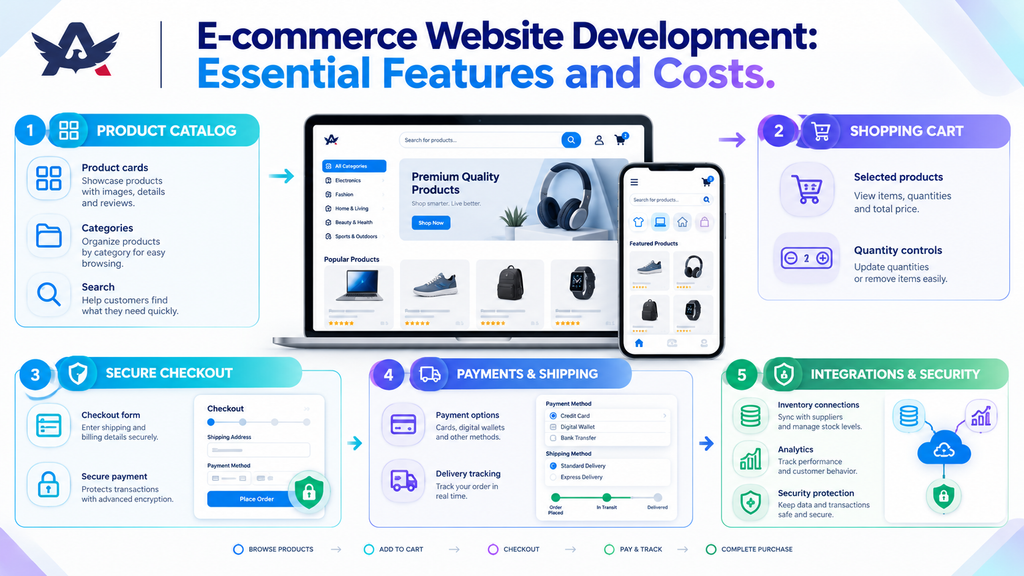
Online stores cost more because they do more. They need product pages, search, a cart, checkout, payments, taxes, shipping rules, and strong security. Each piece needs design and testing, so web design pricing for a store runs higher than for a brochure site.
Platform choice sets your starting point. Forbes Advisor figures, reported by theCSS Agency, list Squarespace plans at $25 to $139 per month and Wix from $17 per month, with Shopify running $39 to $2,300 per month plus transaction and app fees. Another guide from DBB Software lists Shopify at $29 to $299 or more per month. Plans and billing terms change, so check each platform’s pricing page before you commit.
Build costs depend on who does the work. First Pier lists typical Shopify ranges of $3,000 to $10,000 for a freelancer build, $10,000 to $30,000 for a small agency, $30,000 to $80,000 for a mid market agency, and $80,000 to $250,000 or more for enterprise Shopify Plus builds. OuterBox says a fully custom ecommerce site often lands between $25,000 and $150,000 or more.
Hidden store costs sneak up fast. Paid apps, payment fees, product photography, data migration, shipping software, and tax tools all stack. Hosting and security needs grow with traffic. MAK Digital Design suggests budgeting 15% to 25% of the initial development cost each year for maintenance.
Decide between a platform and a custom build first. Most new stores should start on a hosted platform. Custom builds make sense when your model needs vendors, special pricing rules, or deep connections that a platform can’t handle. Otherwise, you’re paying to build features you could simply rent.
Identify the Factors That Affect Website Development Cost
Ten factors move your quote up or down. Know them, and you can steer the price.
- Page count and page types. Ten pages on one template cost less than ten unique layouts.
- Design level. A template with your logo costs less than a fully custom design.
- Features. Booking, search, memberships, calculators, and logins each add hours.
- Platform. WordPress, Shopify, Webflow, Wix, and custom code all price differently.
- Content. Writing copy, shooting photos, and editing video can rival the build itself.
- Who builds it. DIY, freelancer, small agency, and large agency rates sit far apart.
- Timeline. Rush work usually costs extra, so plan early.
- Accessibility. Elementor says manual accessibility audits cost $2,000 and up.
- SEO and speed setup. Elementor puts a basic technical SEO setup near $500.
- Revisions and meetings. Extra rounds and slow feedback stretch the schedule and the bill.
Scope sits at the top of the list. Cut a feature and the quote drops. Add one mid project and it jumps.
Pixeto, citing Clutch survey data, says scope changes rank as the leading cause of cost increases. A single extra feature can swing your website design cost by thousands, which is why a signed scope matters so much.
Here’s how to use this list. Write your must haves, nice to haves, and later ideas on separate lines. Then ask each bidder to price all three groups.
You’ll see which features carry the biggest cost, and you can decide with real numbers instead of guesses. That habit keeps the cost of website design under your control instead of the vendor’s.
Account for Domain, Hosting, and SSL Certificate Expenses
These three costs look tiny next to a design bill. Still, they renew every year, and they cause real headaches when ignored. Add them to your website design budget now.
Domain name. Network Solutions lists domains at $10 to $35 per year. Standard .com renewals often sit between $10 and $20, while privacy add ons run about $5 to $15 per year.
Many providers discount year one and raise the price at renewal, so check the renewal rate. Register the domain in your own name, not your developer’s.
Hosting. Hosting is where your site lives. Network Solutions says basic shared hosting can start at $2 to $15 per month, and managed plans often run $10 to $50 per month.
Gravitate lists VPS or cloud hosting at $30 to $150 per month and premium managed hosting at $150 to $300 or more. Most small business sites do fine on shared or managed hosting. Busy stores and apps need more power.
SSL certificate. SSL puts the padlock in the browser and encrypts data between your site and visitors. Free options like Let’s Encrypt work for many sites.
Network Solutions lists paid domain validation certificates at about $4 to $60 per year, organization validation at $50 to $150, and extended validation at $200 to $300 or more.
Don’t forget business email. Bitcatcha lists email hosting at $19 to $216 per user per year. A professional address like you@yourbusiness.com builds trust, and a free webmail address can look unfinished on an invoice.
Pro tip. Put every renewal date on your calendar, and turn on auto renew. An expired domain can take your whole site offline.
Closing Remarks
Your website is an investment in your business, so plan your budget around your goals, audience, and required features.
A clear Website Design Process helps you control costs, avoid unnecessary revisions, and build a site that supports long-term growth. Compare pricing, check portfolios, and ask what each package includes before hiring a designer.
Remember to budget for hosting, maintenance, content, and future updates, not just the initial build.
American Design Agency LLC can be included as an option for businesses exploring professional website design services. Choose a solution that fits your budget and gives your business room to grow.
Let’s Build a Website That Grows With Your Business
Have a website project in mind? American Design Agency LLC offers professional website design solutions tailored to your business goals. Let’s discuss your requirements and find the right solution for your budget.
Book Your Free Project Consultation Today!Frequently Asked Questions
Yes, web design remains worth it in 2026 because businesses need websites to build trust, attract customers, and generate leads. A well-designed website supports SEO, improves user experience, and makes website design cost a valuable business investment.
The amount you should pay depends on your project size, features, and designer’s experience. Web design pricing can range from hundreds to thousands of dollars. Compare web design services pricing, deliverables, and ongoing fees before hiring.
Web design cost depends on your website’s size, functionality, and customization needs. A simple business website may cost hundreds to a few thousand dollars, while complex projects cost more. Set a realistic website design budget before requesting quotes.
The seven C’s of website design are context, content, community, customization, communication, connection, and commerce. These principles help businesses create useful, engaging websites that support visitors’ needs and make the cost of website design more worthwhile.
The seven steps in web design include planning, research, wireframing, visual design, content creation, development, and testing. Following these steps helps control your website design budget, reduce revisions, and ensure your website meets business goals.
A simple website may take one to three weeks, while a small business website often takes four to eight weeks. Project complexity, content readiness, and revisions affect web design pricing and the overall delivery timeline.
The five golden rules of web design are clarity, consistency, simplicity, responsive design, and easy navigation. Following these principles helps businesses create user-friendly websites, improve engagement, and get more value from their website design budget.
