


SEO keywords are like the sweaty, desperate pick-up lines of the internet. You whisper them into the ear of a cold, unfeeling algorithm, hoping it finds you attractive enough to put on the front page.
If you pick the wrong ones, you end up in the digital equivalent of a basement, alone and unclicked.
If you pick too many, you look like a frantic salesman.
If you pick too few, nobody knows you exist.
They are the bridge between a user’s problem and your solution. Mess this up, and your business dies in the shadows of page ten.
How to Estimate the Right Number of Keywords for Your Site?

Stop asking how many keywords for Seo as if a magic number exists. Your crawl budget and domain authority dictate your limits. A new site cannot rank for ten thousand terms overnight.
You need a core set of primary terms and a secondary layer of supporting entities. Focus on your ability to produce high-quality content for each term. If you spread your link equity too thin, you fail. Start with twenty to fifty core clusters.
Expand only when you dominate those initial spaces. Every page should target one main concept and three to five variations. Oversaturating your site with thin pages kills your rankings.
Google penalizes redundant content that serves no unique purpose. Rank for what you can actually win.
Think about your internal resources. Do you have the staff to maintain five hundred pages? If the answer is no, then your keyword count is too high. High-performing sites prioritize depth over breadth.
You want to become a topical authority. This means covering a subject so thoroughly that Google must rank you.
Each keyword requires a commitment of time and backlinks. Do not pick a number out of thin air. Base your estimate on your budget and your competition.
Choosing Keywords That Match Your Audience and Goals
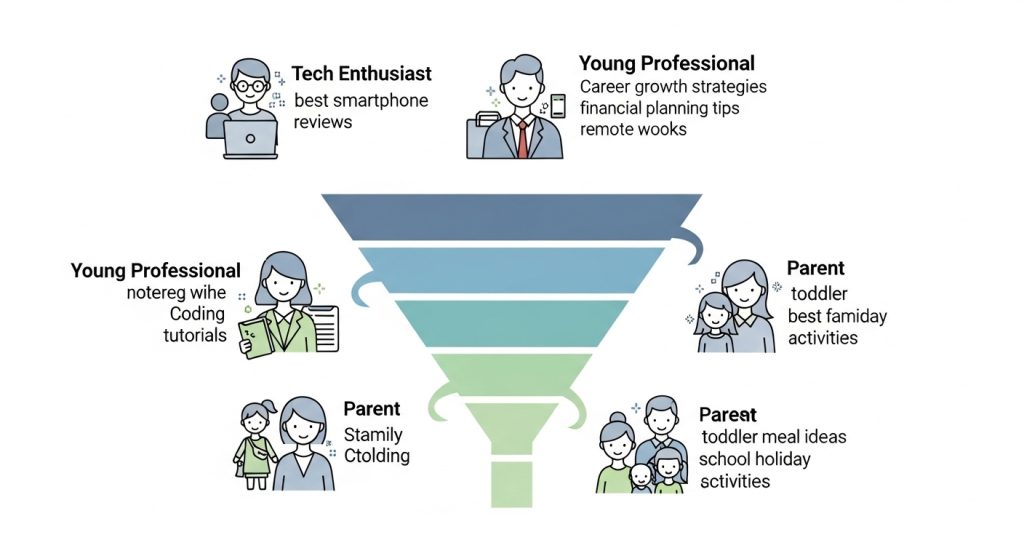
You must map every word to a specific stage of the buyer journey. Users searching for “what is” are not ready to buy. They want education. Stop forcing sales pages on informational queries.
You waste money and destroy your bounce rate. Look at the Search Engine Results Page for your target terms. Does Google show blogs or product pages? If you provide a blog when the user wants a shop, you lose.
Define your conversion goals before you touch a research tool. Every keyword must serve a business objective. High volume means nothing if the traffic never converts. Narrow your focus to terms that bring qualified leads.
Aggressive targeting beats broad visibility every time. Your audience has specific pain points. Use language that mirrors their problems. If you sell enterprise software, avoid hobbyist terminology. Professional buyers use technical jargon. Your keyword selection should reflect that level of sophistication.
Avoid attracting the wrong crowd to boost your traffic metrics. Quality traffic carries a price, and that price is disciplined selection. Every word you target should move a prospect closer to a transaction. Stop chasing empty numbers and start chasing revenue.
Finding the Balance Between Broad Terms and Long Tail Phrases
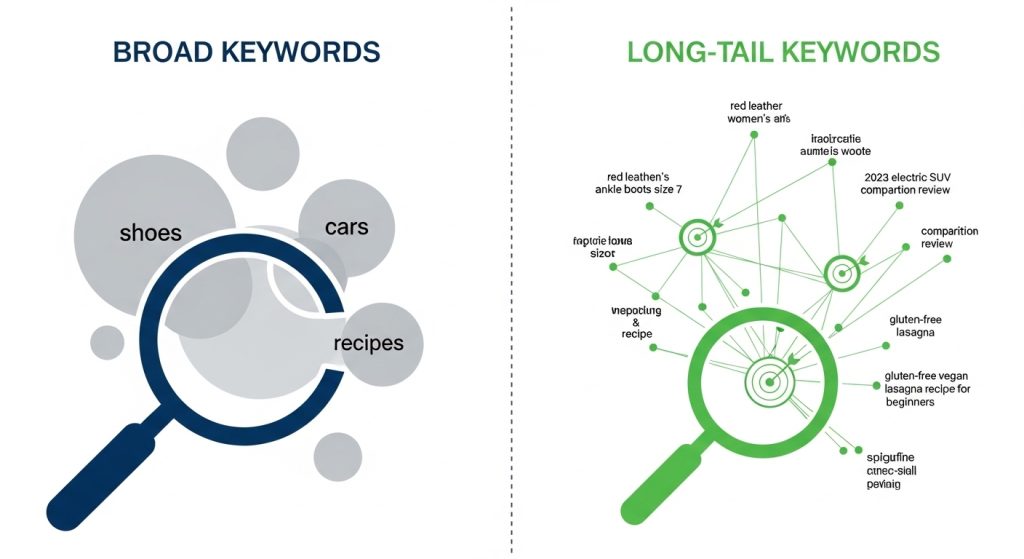
Broad terms are vanity metrics for people who like pretty graphs with no revenue. You will not rank for “shoes” against Amazon. Long tail phrases represent seventy percent of all search traffic. These specific queries show high intent.
A person searching for “red waterproof running shoes size 10” is holding a credit card. Capture those users. Balance your portfolio by using broad terms as your pillar page topics.
Use long tail phrases for your cluster content. This internal linking structure proves your expertise to search bots. You build a web of relevance that supports your main themes.
Stop chasing ego keywords. Invest in the specific phrases that your actual customers type into the search bar.
Long tail keywords often have lower competition and higher conversion rates. They allow you to answer specific questions that broad terms ignore. You can dominate small niches while you slowly build the strength to tackle larger ones.
A healthy site has a mix of high-volume “head” terms and thousands of “tail” variations. This protects you from algorithm shifts. If one broad term drops, your long tail traffic keeps the business alive. Diversify your keyword portfolio like a financial professional.
Using Data to Guide Your Keyword Selection Process

Gut feelings belong in gambling and not in search strategy. Scrutinize the Keyword Difficulty score. Evaluate the Click Through Rate potential. Many queries now result in zero-click searches because Google provides the answer in a snippet.
Avoid those traps. Analyze the Cost Per Click data even if you only care about organic results. High CPC indicates high value and strong competition.
Use Search Console to find keywords where you already rank on page two. These represent low-hanging fruit. A small effort moves these to page one.
Hard data exposes the truth about your market. Ignore the noise and focus on metrics that correlate with revenue. Stop guessing and start measuring. Look at the trends over the last twelve months.
Is the keyword dying or growing? Use TF-IDF analysis to see what terms your successful competitors use. This mathematical approach ensures you cover the topic completely.
Data removes the ego from the decision process. If the numbers say a keyword is too hard, believe them. Redirect your energy toward winnable battles. Your success depends on your ability to interpret spreadsheets and turn them into content plans.
Tools and Techniques for Efficient Keyword Research
Professional search experts avoid free tools that provide junk data. You need access to comprehensive databases that track historical SERP movements. Use tools that reveal the gap between you and your competitors. Identify the phrases they rank for that you lack.
This gap analysis forms the backbone of a winning strategy. Extract data from Google Search Console to see what actually brings people to your site. Use Python scripts to group thousands of keywords into manageable clusters.
This automation saves time, but you must apply human logic to the final selection. Look for patterns in search volume trends. Seasonal spikes can ruin your strategy if you do not plan. Build a stack that provides granular insights into user behavior.
Scrape “People Also Ask” questions to find the exact phrasing your audience uses. This provides a roadmap for your content structure. High-level research requires looking past the surface-level volume.
You must understand the intent behind the click. Use specialized software to track your rankings daily. Real-time feedback allows you to pivot when a strategy fails. Technical mastery of your tools separates the amateurs from the experts.
Adjusting Your Keyword List as Your Site Grows
Your keyword list is not a static document. It is a living plan. As your domain authority increases, you can target more competitive terms. Prune underperforming pages that drain your crawl budget. If a keyword has not delivered results in six months, kill it or change the strategy.
Refresh old content to include new related entities that have emerged. Search intent changes over time. What worked last year might fail today. Monitor your competitors for new terms they start targeting.
Expansion requires a surgical approach. Do not just add words for the sake of volume. Add words that fill gaps in your topical authority. Growing your site deepens your relevance in your niche.
You might start with local terms and move toward national ones. This progression must be logical. Do not jump into high competition waters without the necessary backlinks. Reinvest your wins into harder keywords. If a certain topic performs well, double down on it.
Create more granular content around that success. This “moat” protects your rankings from newcomers. Constant adjustment keeps you ahead of the curve. Static sites eventually sink.
Measuring Which Keywords Deliver the Best Results

Traffic is a lie if it does not lead to a transaction or a lead. Track your conversions at the keyword level. Identify which phrases have the highest return on investment. Some low-volume terms are your best customers.
Use attribution models to see how keywords work together across multiple visits. Watch your rankings, but prioritize your bottom line. Use heatmaps to see if users find what they expect after clicking your link.
If people leave immediately, your keyword does not match your content. High bounce rates signal to Google that your page lacks value. Correct these mismatches immediately.
Search success is about the quality of the interaction after the click. Evaluate your “share of voice” in your industry. See how much of the total search volume you capture compared to your rivals.
Use this data to justify your marketing spend. If a keyword brings thousands of visitors but zero sales, it is a liability.
Focus your resources on the winners. True expertise comes from knowing what to ignore. Refine your list until every word earns its place on your server.
Frequently Asked Questions
Focus on one primary keyword and three to five secondary variations per page. Attempting to rank for dozens of unrelated terms confuses search engines and ruins your topical authority. When you wonder how many keywords for seo a single page needs, remember that relevance beats volume. Stick to a tightly clustered set of related concepts to ensure your content remains focused.
No universal number exists for an entire website. Your strategy depends on your site size and niche competition. Small sites might start with fifty terms while large enterprises track thousands. If you ask how many keywords for seo you need, look at your content production capacity. Quality beats quantity every time. Focus on terms that your brand can realistically dominate.
Aim for one main topic and several semantic variations. Blog posts succeed when they thoroughly answer a specific user intent. Including too many unrelated terms triggers spam filters. When determining how many keywords for seo a post requires, prioritize the natural flow of information. Use your primary term in the title and subheaders to signal relevance to crawlers and readers.
Google prefers depth and accuracy over keyword counts. Stuffing pages with numerous terms creates a poor user experience. The algorithm favors pages that satisfy the search intent of a specific query. People often ask how many keywords for seo Google wants, but the truth lies in topical coverage. High-quality content naturally includes related terms without forcing them into sentences.
Limit your SEO title to one primary keyword to avoid clutter. Your meta description should feature that same keyword and one secondary variation. Crowding these small spaces confuses both users and search bots. If you’re wondering how many keywords for SEO belong in snippets, keep it simple. Clear and concise messaging improves click-through rates far more effectively.
Avoid using the same primary keyword on different pages. This creates keyword cannibalization, where your own pages compete against each other in search results. This practice splits your link equity and confuses search engines. Instead of asking how many keywords for seo you can repeat, focus on unique intent for every URL. Assign one distinct primary term to each page.
Target as many long tail keywords as your content allows. These specific phrases often represent the majority of search traffic. They show higher intent and convert better than broad terms. When planning how many keywords for SEO your strategy involves, include dozens of long-tail variations. These phrases build a strong foundation of niche authority and drive qualified leads.
Forget about specific density percentages. Modern search engines use natural language processing to understand context. Repeating a word too often makes your writing unreadable and looks like spam. If you ask how many keywords for seo density requires, focus on writing for humans. Use synonyms and related entities to help the algorithm identify your topic without repeating yourself.
Overloading a page with terms leads to keyword stuffing penalties. This aggressive tactic ruins your credibility with search engines. Your rankings will drop if the algorithm detects unnatural patterns. When considering how many keywords for seo are safe, prioritize readability. A page that tries to rank for everything usually ranks for nothing. Maintain a clean and focused content structure.
Start with a concentrated list of twenty to thirty high-value terms. Small businesses often lack the resources to compete for broad national keywords. Focus on local terms and specific services you provide. If you ask how many keywords a small site needs for SEO, prioritize relevance over reach. Dominate your local market before expanding your target list further.
Conclusion
Stop treating SEO like a game of volume. Success depends on the surgical placement of high-intent terms that match your technical capabilities. When you ask how many keywords for seo are necessary, remember that authority stems from depth.
Prune weak pages and focus your energy on winning specific clusters. Dominate your niche by providing the best answers. If your data indicates a keyword fails, cut it and move forward.
Maximize Your Website’s SEO with the Right Keywords
Choosing the right keywords doesn’t have to be confusing. With a smart strategy and a little guidance, your website can attract the right visitors and grow your business.
We work with businesses like yours to find the most effective keywords and optimize content through a trusted SEO company in Georgia that understands real results.
Book your free project consultation call
We’ll review your website, find the most effective keywords, and show you actionable ways to improve visibility and drive more qualified leads.
📞 Call: +1 (478) 216-2679
📧 Email: info@americandesignagencyllc.com
